If you’ve ever tried to check company fundamentals in Nepal, you know the struggle. The official NEPSE website is functional but often slow and clunky. Third-party portals exist, but they are usually riddled with ads, confusing layouts, and paywalls for basic info.
I built NTX (Nepal Trade Xplorer) to solve this. It’s a clean, fast, and open-source stock screener designed for one thing: giving you a clear snapshot of market data without the noise.
The Problem: Noise and Friction
As a developer and an investor, I found myself constantly frustrated by the existing tools when I just wanted to check a company’s status.
- Latency: Loading a simple company page often took seconds.
- Ads: Pop-ups and banner ads distracted from the data.
- UX: Important metrics like P/E ratio, paid-up capital, or dividends were often buried or hard to compare.
I wanted a tool that felt instant, looked premium, and respected the user’s time.
The Solution: Speed and Simplicity
NTX is designed to be a “pro” tool that is accessible to everyone. There are no ads, no trackers, and no paywalls. The interface is highly dense, prioritizing data per pixel.
Key features include:
- Stock Screener: Quickly filter companies based on fundamental metrics.
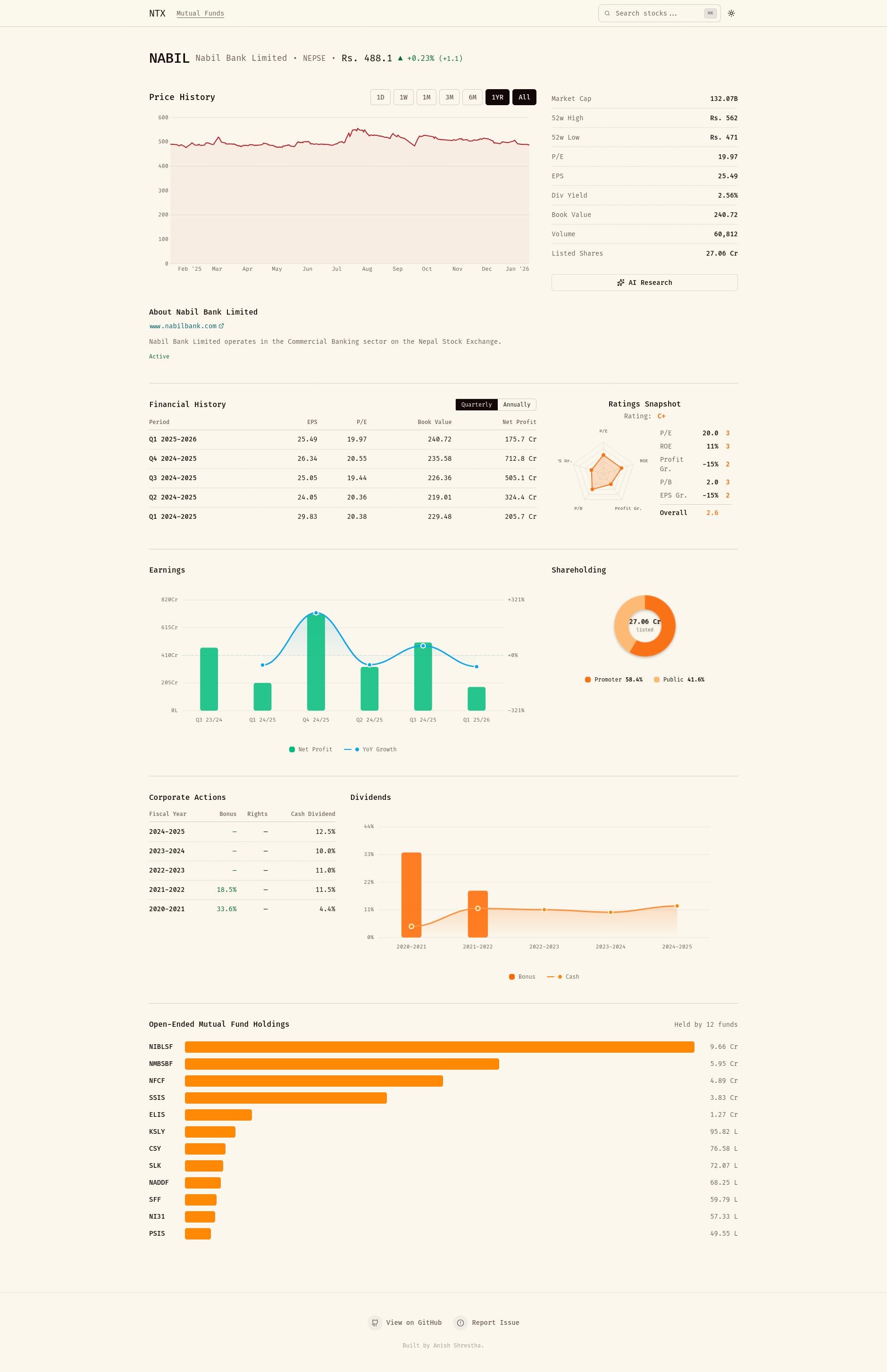
- Company Snapshots: A dense, single-page view of a company’s key metrics, price history, and details.
- Market Overview: See top gainers, losers, and index performance at a glance.
Under the Hood: The “Over-Engineered” Stack
Let’s be honest: this stack is completely over-engineered for a stock screener.
I could have built this with a simple Next.js app and a few API calls. But NTX wasn’t just about building a product; it was a playground for me to learn and experiment with a modern, scalable “cloud-native” stack.
Here is the tech stack I chose to learn:
Backend: Go + ConnectRPC
I chose Go for the backend to learn how to build production-grade services.
- Go-Nepse: The core data fetching logic comes from go-nepse, a library I wrote to handle NEPSE’s unique authentication challenges.
- ConnectRPC: Instead of standard REST, I used ConnectRPC. It allows me to define my API schema in Protocol Buffers (Protobuf). This ensures strict contracts between my frontend and backend—if I change a field in the backend, the frontend build fails immediately.
Frontend: SvelteKit
SvelteKit is my framework of choice for its incredible performance and developer experience.
- Reactivity: Svelte’s compiler-based approach means less runtime overhead.
- SSR: Server-Side Rendering ensures the content is crawlable and loads instantly.
I used Tailwind CSS for styling and shadcn-svelte for the UI components.
Challenges & Lessons
The biggest challenge was data normalization. NEPSE’s raw data can be inconsistent—sometimes a company name is spelled differently across endpoints, or a symbol changes. Building a robust ingestion pipeline that handles these edge cases gracefully was a major learning experience.
Conclusion
NTX started as a weekend project to scratch my own itch and to over-engineer a solution for the sake of learning. It has grown into a mature, open-source platform.
If you are interested in Go, SvelteKit, or just want to see how a modern full-stack app is put together, check out the code.
Check out the code: github.com/voidarchive/ntx